
The Case Against Wage Labor

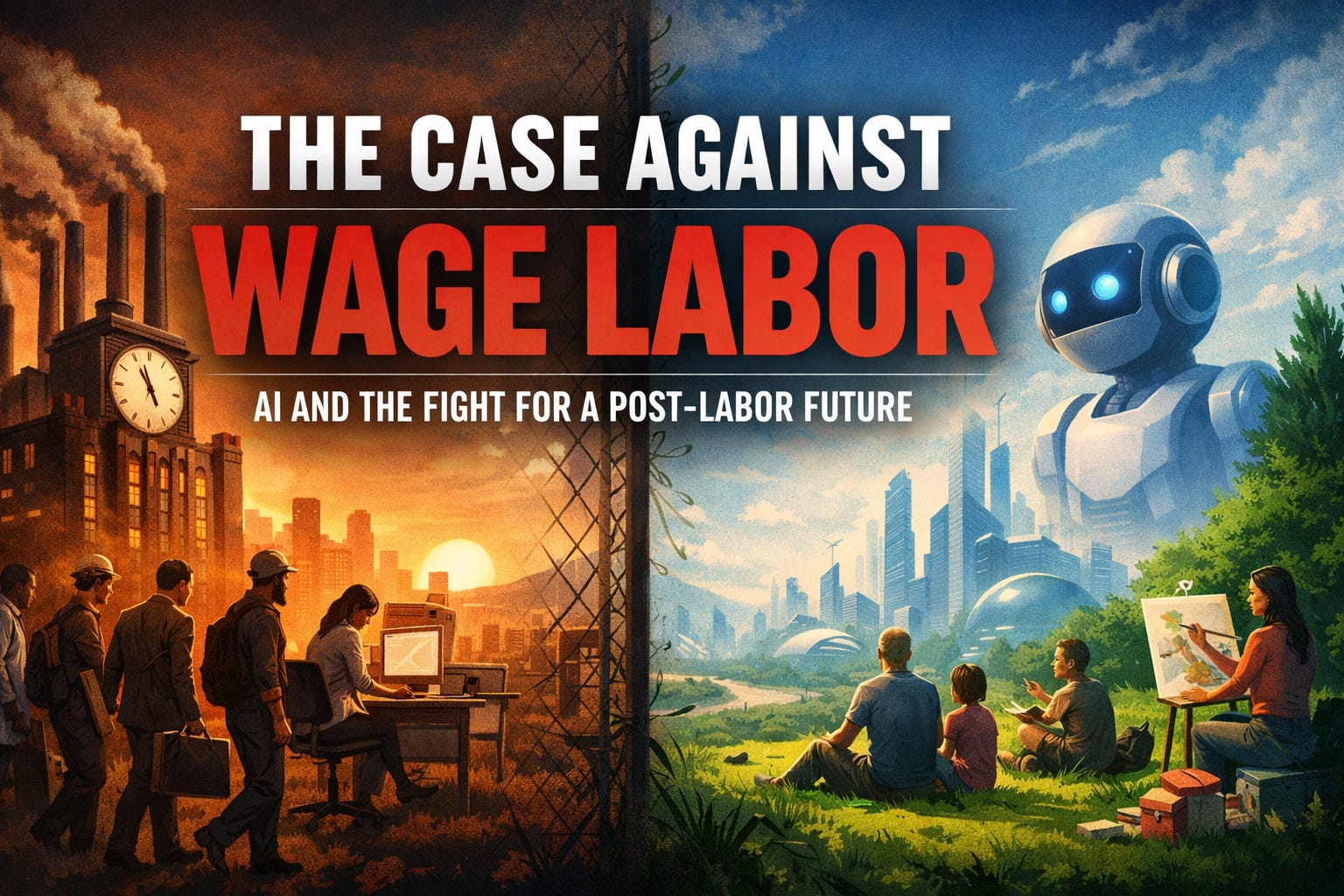
Why the current labor system damages human life, concentrates power, and should be replaced by a real post labor economy
We built a society where survival depends on economic obedience
The central problem with the modern labor system is not simply that people work. It is that access to the basics of life is still tied to selling labor in the market.
Most people do not work because they freely chose the best use of their time. They work because housing, food, healthcare, security, and dignity are conditional. If they stop producing income, their stability begins to collapse. That is not a neutral arrangement. It is a system of dependence.
A society cannot honestly call itself free when most people must constantly sell their time just to remain safe.
Labor under this system is not mainly about meaning
Defenders of the current order often say that work gives people purpose. Sometimes it does. But that is not what the system is designed to maximize.
It is designed to maximize output, compliance, and profitability.
Meaningful work certainly exists. So does work that is socially useful and deeply fulfilling. But huge parts of the labor system are not organized around meaning at all. They are organized around necessity. Millions of people spend the majority of their waking lives under pressure, performing tasks they would not choose under conditions they did not design, for institutions they do not control.
That is not purpose. That is compulsion with a respectable public image.
The system keeps people busy enough to survive, but not free enough to challenge it
One of the most destructive features of wage labor is that it consumes the very capacities people would need to imagine something better.
People come home exhausted. They postpone relationships, creativity, civic life, reflection, health, and learning because their energy has already been spent. They are told this is maturity. In reality, it is often exhaustion normalized.
A population under constant financial pressure becomes easier to manage. People who fear losing income are less likely to resist bad institutions, less likely to take risks, and less likely to demand structural change. The labor system is not just an economic mechanism. It is also a political stabilizer for existing hierarchies.
That is one reason the system is defended so aggressively. It does not only produce goods and services. It also reproduces dependence.
Productivity gains have not translated into freedom
This is one of the clearest signs that something is fundamentally wrong.
For generations, technology has made workers more productive. Output per worker has risen. Systems have become faster, more efficient, and more automated. In principle, this should have reduced the burden of labor and expanded free time for everyone.
But that is not what happened.
In practice, the gains have mostly flowed upward. Owners of capital, infrastructure, platforms, and intellectual property captured a disproportionate share of the benefits, while ordinary workers often faced stagnant security, higher expectations, and more intense forms of monitoring and pressure.
The issue is not that technology failed. The issue is that the system channels technological progress into private accumulation instead of shared liberation.
The labor system enriches elites because it was built to do so
This is the uncomfortable truth at the center of the whole arrangement.
Workers generate value, but the commanding share of long term wealth goes to those who own the productive assets. The more dependent people are on wages, the stronger this structure becomes. Labor remains replaceable. Capital remains dominant.
This creates a society where the majority remains economically necessary but politically weak, while a smaller class accumulates ownership, influence, and insulation from risk. The result is not just inequality of income. It is inequality of freedom.
Some people can refuse bad conditions. Others cannot. Some people own systems. Others must submit to them.
That is why the labor question is not just about jobs. It is about power.
AI creates the first real opening for a post labor economy
This is why AI matters at a civilizational level.
For most of history, there was a hard material reason why large scale human labor was unavoidable. Societies needed enormous amounts of direct human effort to produce enough food, infrastructure, administration, knowledge, and coordination to function.
That constraint is beginning to break.
If advanced AI and automation can perform a growing share of cognitive and administrative work, then the old assumption that most people must remain tied to labor markets becomes less defensible every year. Once machines can do more of what humans were forced to do for survival, the moral logic of wage dependence starts to collapse.
At that point, the real question is no longer whether people can be replaced in many forms of labor. The real question is why access to life should still depend on labor at all.
A post labor economy would not remove meaning from human life
This fear is deeply overstated.
Human beings do not need economic coercion in order to care, learn, build, invent, create, or contribute. In fact, many of the most important parts of life are already poorly rewarded or not rewarded at all by the market. Parenting, community care, friendship, art, study, self development, and civic participation are all foundational to a good society, yet the labor system often treats them as secondary because they do not always generate immediate profit.
A post labor economy would not erase activity. It would change its structure.
People would still pursue mastery, status, contribution, and recognition. But these would no longer be tied so tightly to survival. That distinction matters. Activity chosen under freedom is fundamentally different from activity performed under pressure.
Human worth must be separated from market value
One of the worst moral failures of the current system is that it teaches people to confuse their value as human beings with their value in the labor market.
If someone is highly paid, they are assumed to matter more. If someone cannot work, or works in roles the market underprices, their contribution becomes easier to ignore. This distorts moral judgment at a basic level.
A decent society should begin from a different premise: that people deserve security because they are people, not because they currently satisfy demand in a market.
That principle becomes even more important in an age of AI. Once productivity can increasingly come from automation, continuing to tie dignity and survival to labor is not rational. It is punitive.
The best use of AI is not to make workers more efficient
It is to make compulsory labor less central to life.
That would be one of the greatest advances in human history.
A serious post labor economy could reduce stress, improve mental health, expand family time, enable lifelong learning, strengthen communities, increase creative output, and give people more room to become who they actually are rather than who the labor market needs them to be.
This is not a fantasy of laziness. It is a vision of a civilization mature enough to use its tools for human flourishing instead of permanent economic pressure.
But AI will only liberate humanity if its gains are shared
There is nothing automatic about this transition.
If AI remains narrowly owned, then productivity gains will once again flow to a small number of firms and asset holders. In that scenario, people could lose bargaining power, lose jobs, and become even more dependent while a small elite becomes wealthier than ever.
That is not a post labor future. It is a high tech version of oligarchy.
A real post labor economy would require structural change. The gains from AI would need to be socialized in meaningful ways through public wealth funds, universal income floors, broad ownership, abundant public services, and guaranteed access to the essentials of life. Without that, automation will not free people. It will simply deepen asymmetries of power.
The deepest question is moral, not technical
We already know the current system leaves millions exhausted, anxious, and trapped in forms of work that drain life rather than enrich it. We already know productivity gains have not been fairly distributed. We already know that vast amounts of human potential are wasted by a model that subordinates life to economic necessity.
AI now forces a choice.
We can use it to preserve a system where most people remain dependent and a few capture the gains.
Or we can use it to move toward a society where security is unconditional, freedom is real, and technological progress finally serves the many instead of the few.
That is the real promise of a post labor economy.
Not the end of effort.
Not the end of ambition.
Not the end of contribution.
The end of having to earn the right to live.
Brilliant, i think asymmetries of power will continue to deepen, sadly.